
The 2000P Dime
The 2000P dime is considered a modern rarity.
Here’s a bit of history on how this happened.
At the start of the century, mostly due to increased commodity and production costs, the Royal Canadian Mint (RCM) began shifting their coin production away from nickel planchets to cheaper nickel-plated, 92% steel core planchets. The initial test began in 1999 when special “P” coins were minted and released in sets.
Further tooling and testing continued in early 2000 with the release of the first widely circulated steel-cored nickel. The RCM focused on the nickel, and almost 5 million “P” coins were minted and released for circulation. The 2000P nickel, while scarce, is still a desirable coin for a collection.
Aside from the nickels, no other coins from 2000 with the “P” mint mark were released in circulation.
It must be noted that with the new millennium, the RCM was focused on releasing the monthly commemorative coins, and didn’t spend much time on the new quarter’s “P” release. As the millennium project wound down, the RCM continued testing and minted a few dozen (estimated) quarters with the October and December motifs. Less than a dozen of these coins got into the secondary market. The 2000P quarters are considered the most desirable coins in the 2000P series and are extremely valuable.
In order to celebrate the launch of the new plating facility at the Winnipeg mint, the RCM produced 276 special 50-Cent pieces as part of a presentation set. These 50 cent coins are also very desirable to the collector in the secondary market.
It should be noted that no 2000P one cent pieces were produced.
Which leaves us with the dime.
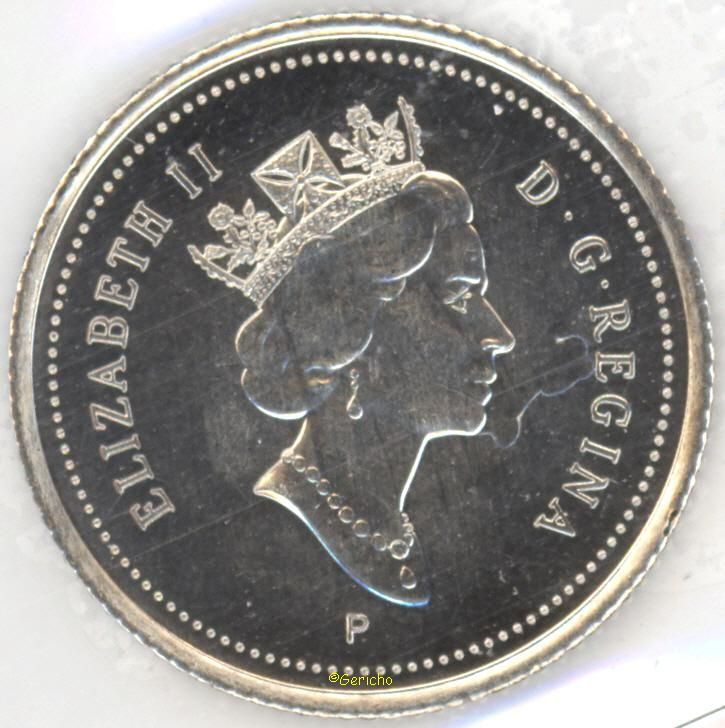
To accommodate the lighter weight of the steel-core dime (2.07g vs. 1.75g), the vending machine industry would need to recalibrate their machines. To assist with this, the RCM loaned out approximately 400 “P” test dimes with the express request that they be returned to the mint upon completion of the testing. It is estimated that between 150-200 were never returned and are considered among the rarest coins in Canada.
For the first few years of the millenium, both steel and nickel coins were produced, the steel core coins have a distinctive “P” (for plated) mint marks on Obverse beneath the Queen’s bust. Gradually the RCM used up their nickel planchet inventory, and by 2006 all coins for circulation were using the steel core planchet - including the one cent coin. It should be noted that the steel core transition introduced all kinds of new and desirable varieties in almost every denomination. Check them out!