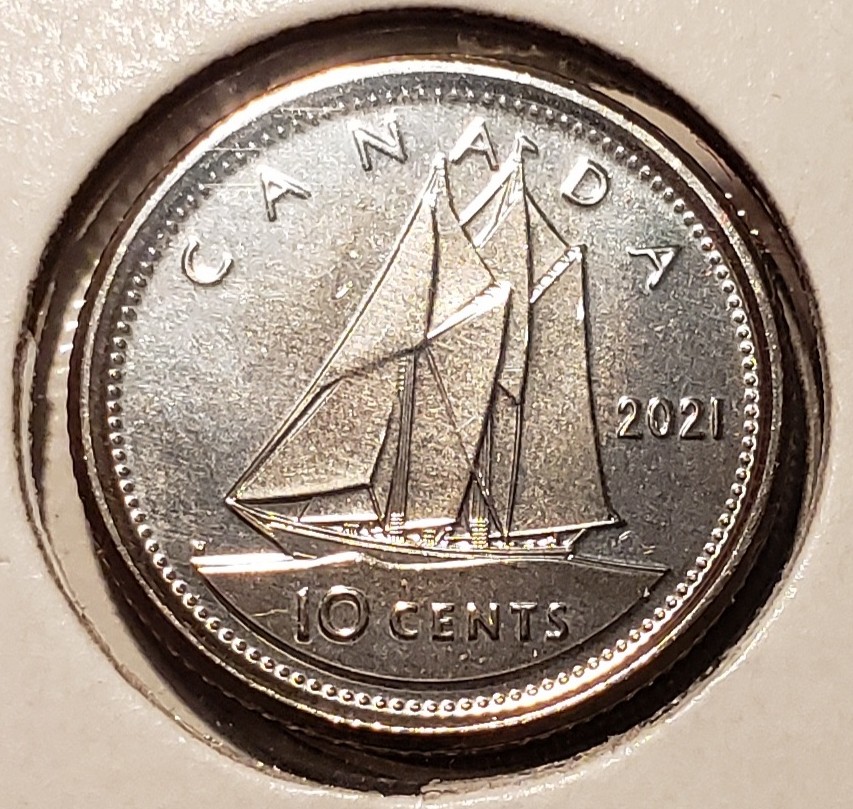
The four 2021 Bluenose dimes. Four?
2021 Canada Dimes
Canadians are very familiar with the schooner dime, but many don't know the revered history relating to this infamous schooner.
The Bluenose was a Canadian racing and fishing schooner launched in 1921 in Lunenburg, Nova Scotia. Designed by naval architect William Roué and built by Smith and Rhuland, she was created to be both a fast racing vessel and a working Grand Banks fishing boat. Thanks in part to her sleek design, the Bluenose quickly earned international fame by dominating the International Fishermen’s Trophy races, defeating American schooners in a series of competitions between 1921 and 1938. She was never defeated in these races, becoming a powerful symbol of Canadian skill, resilience, and maritime pride during a time when the fishing industry was vital to Atlantic Canada’s economy.
Beyond racing, Bluenose worked as a commercial fishing vessel and later as a training ship and goodwill ambassador, visiting ports throughout North America and the Caribbean. After her competitive years, she was sold for cargo service and tragically wrecked and was lost on a reef near Haiti in 1946. An exact replica of the Bluenose was built by the same shipbuilder in 1963. She was christened the Bluenose II.
Bluenose’s image became iconic, and in 1937 it was chosen for the reverse of a new Canadian 10-cent coin. Sculpted by Emanuel Hahn and based on Roué’s original design drawings, the dime cemented Bluenose as a national emblem. To this day, the ship symbolizes Canada’s seafaring heritage, craftsmanship, and determination, making the “Bluenose dime” one of the country’s most recognizable coins.
To celebrate the Bluenose's 100th anniversary, the RCM released three commemorative dimes, each with distinct designs.
For the first time since Bluenose appeared on the Canadian 10-cent coin in 1937, the RCM introduced a new reverse design by Nova Scotia artist Yves Bérubé, featuring the schooner under full sail and double-dated “1921-2021.” To highlight this milestone further, the RCM also issued Canada’s first-ever coloured dime, with blue enamel representing the North Atlantic waters where Bluenose ruled. This same design was also released uncoloured. A fourth version was also released with the traditional design and dated 2021. This fourth version was never released in circulation and soon became the desirable variant highly sought after by collectors.
The 2021 single-date dime is an example of a possible current-date scarcity. When the collector community confirmed there was an elusive "fourth" variant in the notable Bluenose series, no one could confirm the exact number minted, or more importantly, whether it was considered a circulating coin.
Prices for these coins immediately skyrocketed, reaching as much as $100 for an MS66 example. The determining factor in their value was whether the mainstream collecting community would accept the coin as a circulating issue or classify it as Non-Circulating Legal Tender (NCLT), a term typically reserved for "collector edition" coins. The purist collector typically considers NCLT coins inferior and undesirable so collector sets are not particularly popular with those collectors.
If classified as NCLT, production numbers would be on the higher side of typical NCLT mintages. NCLT coins are produced by the mint specifically for collectors and are sold only in special or promotional sets, with mintages that seldom exceed 100,000 sets. These coins are part of the mint's markup and marketing (M&M) strategy.
Although NCLT coins are considered legal tender, the packaging plays an important role in their marketing. Since they're not intended for circulation, these coins are always available in high grades - which is a reason some collectors give them a wide berth.
To increase desirability, the mint promotes multiple sets with low reported mintage numbers, along with a sense of urgency or Fear Of Missing Out (FOMO). In reality, the same coin is repackaged in various cardboard holders with mix and match of denominations. Fortunately, this author and the collector community at large let the market play itself out. The overabundance of sets affected the desirability and because of this, the value of most NCLT coins remains largely stagnant for years. Most sets are subsequently available years later on clearance, and usually well below issue price.
What's interesting to note that while it's common for the mint to repackage identical coins in different plastic holders or cardboard sets, each labelled as a "limited edition" it is often the packaging - not the coin - that becomes collectible. This approach mirrors common consumer marketing strategies.
This brings us back to the 2021 single-date dime. The coins were not released into general circulation and are available only through various "limited-edition" sets. While the mint actively promotes that some sets have maximum production limits of 100,000 or less, the truth is they release various collector sets which increases the mintage numbers significantly. The RCM focuses their marketing on a two prong approach: one for the numismatist, and the other for collector of the coin packaging holder.
In the case of the desirable single date 2021 dime, when all sets are grouped together, the estimated total production of the 2021 single-date dime is approximately 825,000 coins. While this figure places it outside the realm of low-mintage circulating coins and high-mintage NCLT issues, the 2021 single-date dime - although the scarcest of the 2021 Bluenose series - should not be considered a true scarcity when compared to other NCLT coins.
Note: Beware of some unscrupulous dealers who promote "high" and "low" tide versions of the coloured dime to sell products. The colouring on the coins is within the serrated background and are well within the design specification. Unless this silly variation becomes acceptable by the community at large, I would recommend refraining from acquiring these coins for your collection.
Estimated Production of 2021 single date dimes by set:
- First Strike: 250,000
- Oh Canada!: 100,000
- Birthday: 100,000
- Wedding: 100,000
- Baby: 100,000
- Christmas: 100,000
- Uncirculated Proof like set (Pliofilm): 75,000
- Specimen: 30,000
- Klondike dollar edition: No
- Insulin dollar edition: No
- Approximate total: 825,000 coins