
How a Coin Is Made — and Where Things Go Wrong
Follow the coin-making process from metal strip to blank, annealing, upsetting and striking, and learn where Canadian coin planchet flaws, die problems and mint errors can originate.
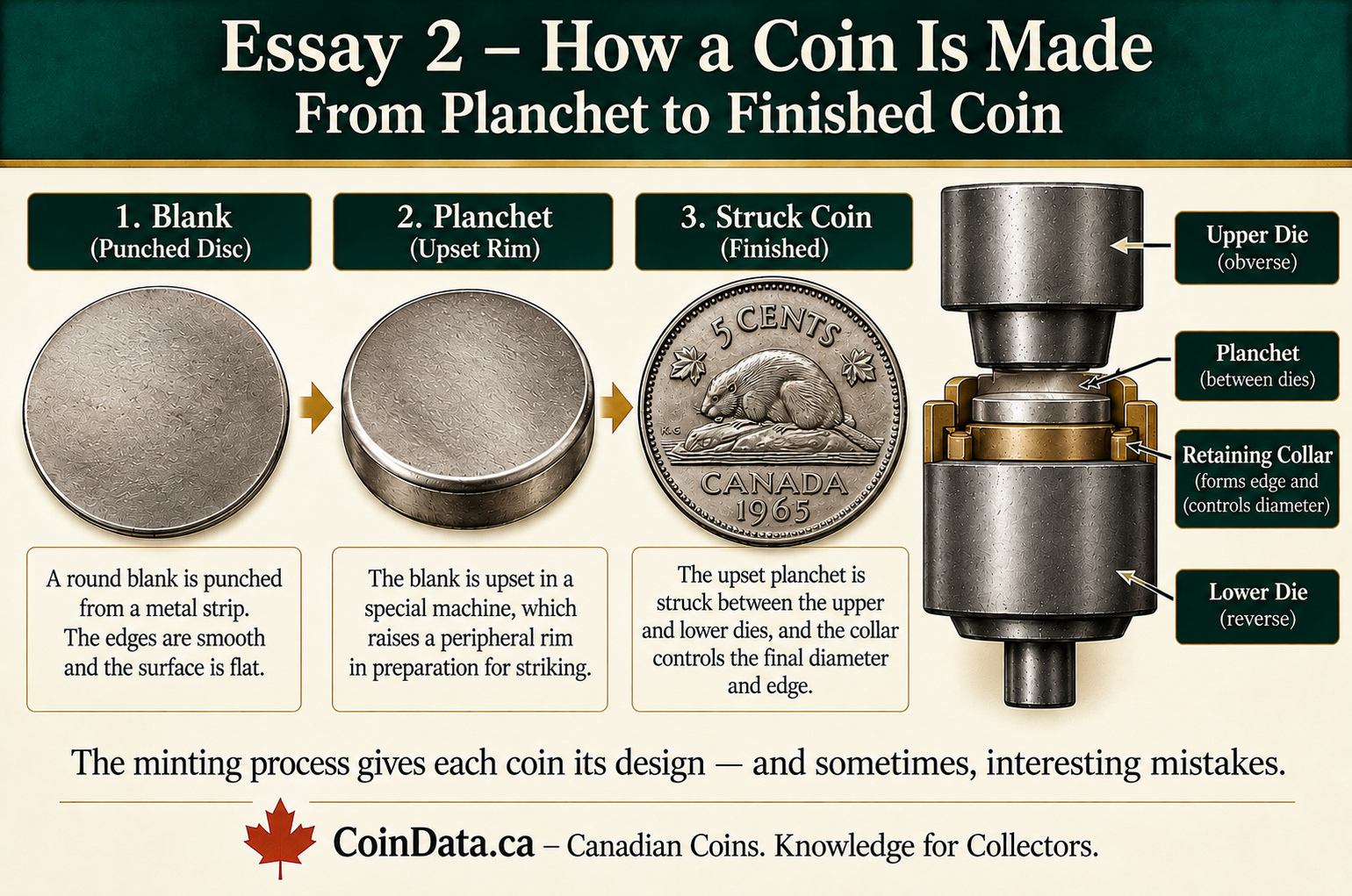
Metal, Strip and Blanking
Coin production begins before there is anything that looks like a coin. Depending on the denomination and production system, a mint may blank discs from metal strip or receive blanks or planchets from a supplier. A blanking press punches discs from strip. Overlap with a previously punched hole or with an edge of the strip produces what collectors traditionally call a clipped planchet, more precisely an incomplete blank or incomplete planchet. The missing portion therefore predates the strike; it is not a piece broken from a finished coin.
Annealing and Surface Preparation
Where required by the production process, blanks are annealed to soften the metal and improve its ability to take the design, then cleaned and dried before later operations. Defects already present in the alloy or metal stock can appear as laminations, inclusions, fissures or splits. On plated coinage, defects in the substrate or plated layers can also produce abnormal surfaces; these must be distinguished from separation caused during striking and from corrosion, chemicals or abrasion after striking.
Upsetting: Turning a Blank Into a Planchet
The upsetting mill forces the edge of a blank upward to create a proto-rim; after this operation the disc is conventionally called a planchet. The rim helps protect the finished design and improves handling and stacking. Upsetting is also diagnostically useful. On many genuine incomplete planchets, the interrupted circumference prevents normal upsetting at the point opposite the missing area, producing the Blakesley effect: weakness or absence of the design rim there, often accompanied by a well-formed edge. Its absence, however, does not by itself prove a clip is false.
Dies: Negative Tools That Create Positive Relief
The dies carry the coin design in negative. Recessed cavities in the die produce raised devices on the coin; raised areas of the die produce recessed areas on the coin. This simple reversal is fundamental. A scratch cut into a die can create a raised line on every coin it strikes. A crack in a die opens a narrow void that planchet metal enters, producing a raised die crack on the coin.
The Collar
The collar normally surrounds and restrains the planchet as the dies close, establishing final diameter and, on many coins, imparting a plain or reeded edge profile. If the planchet is struck outside the collar, it can expand beyond normal diameter; if collar engagement is partial, a stepped edge profile may result. Edge evidence is therefore central to diagnosing broadstrikes and partial-collar strikes.
Striking and Metal Flow
When the dies close, striking force drives planchet metal into the recessed design and laterally until its expansion is restrained by the collar or other surrounding geometry. Authentic striking errors therefore tend to preserve a coherent relationship among the design, rim, edge and abnormality. The metal responds to the geometry of the dies, collar, planchet position and any intervening object.
Why Manufacturing Sequence Matters
A useful diagnostic question is: Could this feature originate at this stage? A lamination originates in the planchet metal; a cud originates in a corner die break; an off-centre design is created during striking. A deep random gouge that cuts across completed design is ordinarily post-strike damage. Manufacturing sequence does not answer every attribution by itself, but it eliminates many impossible explanations.
This educational series draws upon technical publications from the Royal Canadian Mint and U.S. Mint, supplemented by various numismatic references, published research and publicly available resources. Terminology and classification methods may differ among sources. CoinData evaluates these distinctions using observable physical evidence and established minting principles. Photographs illustrate actual coin characteristics; precise die attribution remains provisional unless independently verified.